If you are buying or refurbishing a property in Spain, sooner or later someone will mention the licencia de obras — the building works licence. Here is what it is, when you actually need one and what the process involves.
Planning permission works differently here from the way it does in the UK or Ireland. The licence is issued by your town hall (ayuntamiento) under its own municipal ordinances, so the detail — what needs a full licence, what only needs a notification — changes from one town to the next. What applies in Torremolinos is not necessarily what applies in Málaga.
What is a licencia de obras?
A licencia de obras is the municipal consent to carry out building work. Think of it as planning permission and building regulations approval rolled into a single town hall authorisation — the closest British equivalent, though not an exact one.
You apply to the local council, and specifically to the planning department (Urbanismo). The licence confirms two things: that the work complies with the law in force, and that the corresponding fees have been paid.
Once granted — you may also see it called licencia urbanística or permiso de construcción — it covers either minor works or major works, depending on the scale and complexity of what you are doing.
Planning permission in Spain: when it is needed, and what it lets you do
Start from the assumption that you need a licence for any alteration to the property. That is the safest default and the one that keeps buyers out of trouble. The licence is there to protect the people carrying out the work and the integrity of the building being altered.
Applications fall into two groups, according to how complex the work is.
Minor works licence (licencia de obra menor)
A minor works licence covers work that is straightforward in technical and structural terms, and modest in cost. Broadly:
- Repairs.
- Wall and surface finishes.
- Partition walls, windows and doors.
- Heating systems.
- Drainage.
- Plumbing and electrics.
The rules vary from one town hall to another, but as a general rule only a very short list of jobs needs neither a licence nor a prior notification of minor works (comunicación previa): floor tiling, wall tiling, plastering and replacing existing services like for like. That list is shorter than most buyers assume.
Major works licence (licencia de obra mayor)
So much for the minor category. Here is what pushes a job into the major one. You will need a major works licence to:
- Add a new storey.
- Carry out work on the common parts of a building or multi-unit residential block.
- Carry out work that alters the structure of a building.
- Carry out work that changes the use of the property.
- Extend the building in volume or height.
If you want the full sequence, we set it out in this article on the steps to build a house.
How to apply for a building licence
That covers the two types of licence and when each one applies. The next question is how you actually get one.
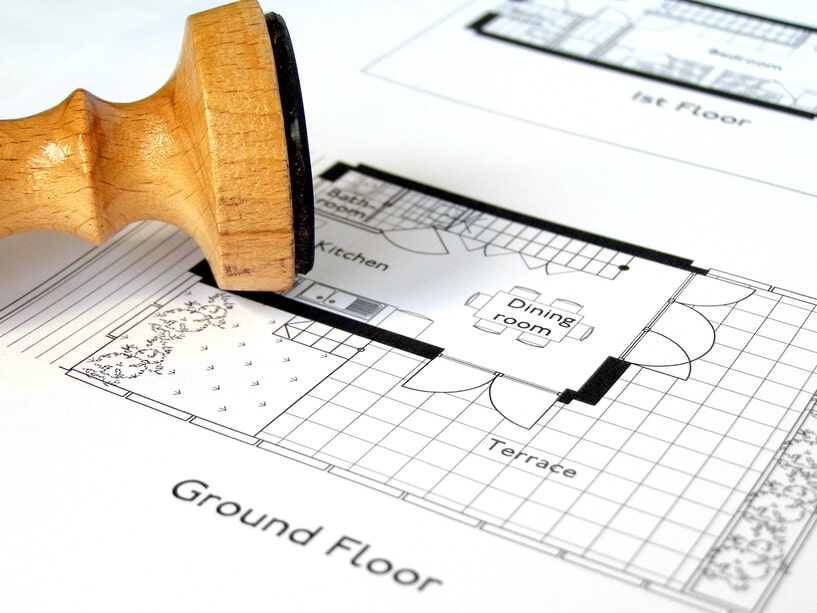
The first step is to appoint a team of architects in Málaga to prepare the technical documentation. That documentation then has to be stamped (visado) by the relevant Colegio de Arquitectos, the regional professional body of architects, which checks the author’s credentials and that the file is formally complete. There is no direct British equivalent to this step, so it is easy to overlook.
After that, you book an appointment (cita previa), pay the fees and lodge the documentation at the town hall. The decision normally arrives within one to three months. Worth building into your programme before you sign anything with a builder.
One point worth being blunt about: the licence covers the works described in the file, and nothing else. If what happens on site drifts from the drawings — a wall moved, a terrace closed in, a pool that was never on the plans — the licence no longer covers it. That gap tends to surface years later, when you come to sell.
If you are weighing up a refurbishment or a purchase on the Costa del Sol and are not sure which route applies, ask before you commit. It is a short conversation, and considerably cheaper than finding out afterwards.