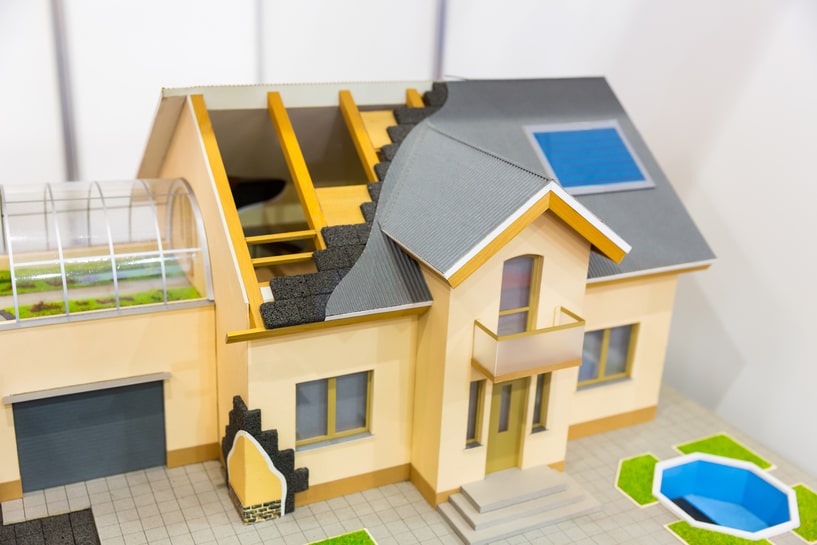
Home insulation in Spain is one of those things nobody asks about at a viewing and everybody thinks about after the first August electricity bill. On the Costa del Sol it has to work in both directions: keeping the heat out from June to September, and keeping it in on the damp January nights that tend to catch northern European buyers out.
Good insulation cuts what you spend on heating and air conditioning, and with it the energy the house gets through. At current energy prices that is no longer a minor line in the running costs of a house. It is worth raising early with your architects in Málaga, before the walls are closed rather than after.
There is the sustainability argument too. A house that stays cool in summer and warm in winter without the air conditioning running all day is cheaper to run and better to live in. That does not happen by chance; it happens because somebody specified the insulation properly. In Spain the building code (Código Técnico de la Edificación, CTE) sets a floor in its energy section, DB-HE. A floor is all it is.
Insulation materials and where each one earns its keep
There is no single right answer. Different materials suit different build-ups, and on a coastal property damp is usually what decides it.
Expanded polystyrene (EPS)
A synthetic material, widely used in Spanish construction and cheap. Its weak point is water: once EPS gets wet it loses insulating capacity. It also has less mechanical strength than the extruded version. Sensible in dry, protected positions; less convincing anywhere damp can reach it.
Extruded polystyrene (XPS)
The usual choice for roofs, because it barely absorbs water and copes well with freezing and thawing. That makes it the better option where damp or cold are pronounced, and it holds up exactly where EPS falls down. A sound specification on most architecture projects.
Polyurethane foam
A foam based on sugar and petroleum derivatives, with 90% closed cells, which is what makes it so slow to let outside temperatures through. It is one of the most common materials in home insulation. It absorbs very little water, so it stands up well to damp, and its balance of performance against price is generally reckoned the best of the group — the material itself is cheap.
Rock wool
Volcanic rock with an organic binder. It works as thermal insulation, but its second job is acoustic, which is worth remembering in a flat with neighbours above and below. It is also non-combustible, which is no small thing.
Glass wool
Glass filaments bound with a non-flammable resin. It resists moisture very well, so it counts as a water-repellent material too.
Where insulation can go
Walls, ceilings, façades and floors. Internal partitions too, and the communal parts of a block: landings, stairwells and lift shafts. The one people forget is the pipework. Insulating the water pipes stops the hot water losing heat on the way to the tap and stops the cold pipes sweating, so the supply arrives at the temperature it left at.
What to sort out before you insulate
Before anyone starts fixing boards to your walls:
- Talk to a specialist, and get advice on your building rather than on buildings in general.
- Make sure specialists are doing the fitting as well. A good material installed badly performs like a bad one.
- Keep an eye on the public grant programmes for energy efficiency and insulation. In Spain each autonomous region runs its own, so on the Costa del Sol it is the Andalusian calls you need to watch, and they open and close on their own timetable.
Home insulation is increasingly hard to treat as an optional extra, and not only for the energy saving. It feeds straight into the energy performance certificate (Certificado de Eficiencia Energética, Spain’s equivalent of the UK EPC), which you will need whether you build, sell or let. Among the phases of building a house it is both required and easy to under-spend on. It is also the one item you cannot inspect once the plasterboard is up.