Few architectural traditions have left such a deep and recognisable mark as Islamic architecture. Its forms, materials and philosophy of space have crossed centuries and borders, and in places like Málaga or Granada they remain part of the everyday landscape.
Islamic architecture characteristics: what defines it
Islamic architecture is not a single style: it developed over more than thirteen centuries across territories stretching from the Iberian Peninsula to Southeast Asia. What unites it is a series of philosophical and aesthetic principles that recur consistently: geometry as language, light as material, water as a sensory element and ornamentation as a way of expressing the sacred.
The most defining elements
The arch
Islamic architecture developed a remarkable variety of arch forms:
- Horseshoe arch: extends beyond the semicircle; highly characteristic of Andalusian architecture (Mosque of Córdoba).
- Pointed or ogival arch: later adopted by European Gothic architecture.
- Multifoil arch: featuring multiple decorative lobes.
- Mixtilinear arch: combining curves and counter-curves; reaches its finest expression at the Alhambra.
The dome and muqarnas
The dome represents the celestial vault — the point of contact between the earthly and the divine. Its most sophisticated form is the muqarnas vault (stalactite vaulting): a three-dimensional structure of overlapping prismatic cells that transforms a ceiling into a breathtaking composition, purely decorative rather than structural.
The courtyard
The courtyard is the organisational heart of Islamic architecture. Its essential elements:
- Central fountain or pool (water carries purifying and climatic value).
- Carefully selected vegetation.
- Colonnaded galleries providing shade and an interior-exterior transition.
- Bioclimatic function: regulates temperature in warm climates.
Notable examples: the Court of the Lions (Alhambra, Granada) and the Court of the Orange Trees (Mosque of Córdoba).
Geometry and ornamentation
In classical Islamic tradition, ornamentation is built around three registers that frequently appear in combination:
- Arabic calligraphy: Quranic verses and inscriptions integrated as decorative bands.
- Geometric patterns: mathematically complex designs covering mosaics, tilework and carved ceilings.
- Arabesque: stylised floral and vegetal motifs in relief on plaster or stucco.
The result is the well-known horror vacui: no surface is left undecorated.
The mosque: the most representative building
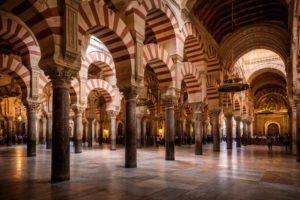
The mosque embodies all the principles of Islamic architecture. Its fundamental elements:
- Qibla: the wall oriented towards Mecca.
- Mihrab: the niche indicating the direction of prayer.
- Minaret: the tower from which the call to prayer is made.
- Ablutions courtyard: the purification space before entering.
Beyond its religious function, the mosque historically served as an educational, judicial and social space as well.
The Andalusian legacy in Spain
The period of Al-Andalus produced a distinctive regional variant of Islamic architecture with its own recognisable features:
- Exceptional refinement of carved plasterwork.
- Glazed ceramic mosaic (zellij).
- Integration of water and garden as core design elements.
- A unique landscape sensibility within the broader Islamic tradition.
In Málaga, the Alcazaba and Gibralfaro Castle are outstanding examples of Andalusian military architecture. The Alhambra in Granada and the Mosque of Córdoba are its most internationally recognised masterworks.
Influence on contemporary architecture
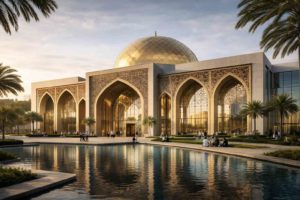
The principles of Islamic architecture remain highly relevant today: the courtyard as a climatic regulator, water and vegetation as design elements, the lattice screen as a light filter and the pursuit of harmonic proportions all connect directly with bioclimatic and sustainable architecture.
In southern Spain, this heritage is especially alive. The architects for houses in Marbella who work within the Mediterranean context frequently draw on these principles — the courtyard, shade, water — adapting them to the needs of the contemporary client. The goal is not to copy forms from the past, but to understand what made them work.
Klick Arquitectos: architecture with memory and vision
Since 2006, Klick Arquitectos has been developing residential, hotel and renovation projects in Málaga and the Costa del Sol with an approach that always starts from context: the place, the client and the local building tradition.
As architects in Marbella, we work on both new builds and renovations, aware that the architectural heritage of this region is a resource worth integrating intelligently into every project. If you are looking for luxury architects who combine technical rigour with sensitivity to context and history, we would love to hear from you.
And if you are interested in learning more about urban planning regulations, we recommend our article on Change of use from commercial to residential: a complete guide.
Frequently asked questions about Islamic architecture
What is the difference between Islamic architecture and Arab architecture?
Arab architecture refers to that produced by peoples of Arab culture. Islamic architecture is a broader concept encompassing all peoples who adopted Islam: Persians, Turks, Berbers, Mughals and Hispano-Muslims, among others. It is therefore far more geographically and culturally diverse.
Why does Islamic architecture avoid the representation of human figures?
The prohibition on depicting living beings in sacred spaces — known as aniconism — led Islamic artists to develop geometry, calligraphy and arabesque as alternative forms of ornamentation with extraordinary sophistication.
What is zellij and how is it made?
Zellij is hand-cut, glazed ceramic mosaic tilework. Each piece is individually cut from enamelled tiles using a hammer and chisel, then fitted together by hand to form highly complex geometric patterns. It is a craft still practised today in cities such as Fez and Marrakech.
What role did Islamic architecture play in medieval European architecture?
Its influence was considerable, particularly through Al-Andalus. The pointed arch, the ribbed vault and carved plasterwork all passed into the Christian world through cultural exchange on the Iberian Peninsula. The Mudéjar style — produced by Muslim craftsmen working for Christian patrons after the Reconquista — is the clearest example of this cultural transfer.