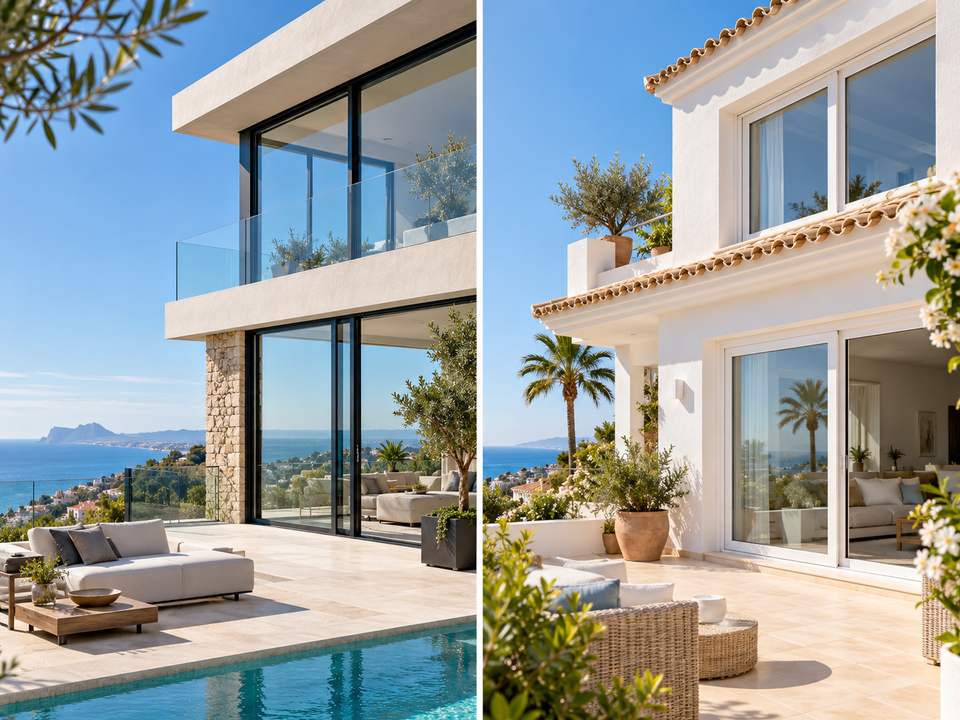
Aluminium windows and PVC windows are the two most widely used materials in new-build homes and full renovations on the Costa del Sol. The key difference: aluminium performs better thermally in hot climates and is more durable against sea salt, while PVC has a lower entry price but is less resistant to intense solar radiation. In the Mediterranean climate of Marbella, Torremolinos or Mijas, this distinction matters more than it might seem.
Aluminium vs PVC: the differences that matter on the Mediterranean
PVC is a good thermal insulator in cold or temperate climates, but on the Costa del Sol, with more than 300 days of sunshine a year and summer temperatures that can exceed 38 °C, it behaves differently. UV radiation degrades PVC over time: it becomes brittle, turns yellow and loses its insulating properties. Aluminium, on the other hand, holds up without warping. What’s more, in coastal areas such as Marbella or Estepona, the sea breeze and salt air speed up the deterioration of materials — aluminium with a thermal break (known in Spain as RPT) is the recommended standard for beachfront properties.
Practical differences between aluminium and PVC in the context of the Costa del Sol:
• Resistance to heat and sun: thermally broken aluminium is the clear winner.
• Thermal insulation: well-installed PVC can be comparable, but it loses performance over time.
• Resistance to coastal salt air: anodised or powder-coated aluminium is unquestionably better.
• Maintenance: virtually none for aluminium; PVC needs its seals and gaskets checked every 5-8 years.
• Price: PVC is 15-25% cheaper to install initially, but it can cost more in the long run.
• Aesthetics and customisation: aluminium comes in any RAL colour, with more refined finishes for design-led architecture.
The west-facing window mistake: why they are the riskiest
On the Costa del Sol, west-facing windows are the ones that suffer most in summer. The afternoon sun hits them directly between 3 pm and 8 pm, when temperatures are already at their peak. A poorly chosen west-facing window — without a thermal break, without low-emissivity glass or without external shading — can raise the indoor temperature of a room by 6 to 10 degrees. The result is soaring air-conditioning bills and a level of thermal comfort that never quite arrives.
The solutions recommended by Juan Goñi, an architect at Klic Arquitectos with more than 20 years’ experience on the Costa del Sol, work in three layers: the choice of frame (thermally broken aluminium), the glass (solar-control double glazing, with a g-value below 0.35 for west-facing windows) and the external shading (shutters or louvres that block the sun before it reaches the glass). The order matters: without external shading, the glass only holds back part of the heat once it has already got in.
Why skimping on windows is one of the most expensive mistakes you can make
In a full renovation or new build in Málaga, windows account for between 8% and 12% of the total budget. The temptation to cut back here is strong — “they’re just windows” — but it is one of the decisions homeowners most often regret years later.
Replacing windows once the work is finished is particularly expensive: the external cladding has to be removed, the wall render around the openings made good and everything repainted. Swapping low-quality windows for mid-to-high-quality ones at that stage can cost 40-60% more than fitting the right ones from the start.
At Klic Arquitectos, the minimum standard we recommend for residential projects on the Costa del Sol is:
• Frame: thermally broken aluminium (RPT) with a break of ≥ 12 mm.
• Glass: 4+12+4 low-emissivity double glazing (Ug ≤ 1.1 W/m²K).
• Seal: high-airtightness perimeter seal (class 4 under EN 12207).
• West/south-facing windows: glass with built-in solar control.
How much do aluminium windows cost on the Costa del Sol? A price guide
Prices vary widely depending on the manufacturer, the system and the dimensions. As a rough guide for residential homes on the Costa del Sol:
• Standard thermally broken aluminium window (1.2 × 1.2 m): €400-700 installed.
• Premium / minimalist aluminium window (concealed frame, solar-control glass): €900-1,800 installed.
• Standard PVC (same size): €300-500 installed.
• Large-format sliding door (3.5 × 2.4 m, for a living room or terrace): €3,000-7,000 depending on the system.
In premium residential projects in Marbella or Benahavís, Klic Arquitectos’ clients usually opt for minimalist aluminium window systems (1-2 cm of visible frame, floor-to-ceiling glass) that bring the landscape indoors. This choice raises the joinery budget, but it is one of the factors with the greatest impact on how the quality of a home is perceived.
Frequently asked questions about windows on the Costa del Sol
Are aluminium or PVC windows better in Marbella?
For the climate of Marbella, and the Costa del Sol in general, thermally broken aluminium is the recommended option. It stands up better to UV radiation, coastal salt air and intense heat without degrading. PVC is a valid alternative on a tight budget, but it needs more maintenance and its durability declines after years of sun exposure.
What is a thermal break in aluminium windows?
It is a barrier of insulating material (usually polyamide) inserted into the aluminium profile to interrupt the transfer of heat between the outside and the inside. Without it, aluminium conducts heat straight through (and cold in winter), cancelling out much of the glass’s insulation. In Andalusia, the CTE (Spanish Technical Building Code) requires a thermal break in climate zones B and C, which cover the whole of the Costa del Sol.
How much can good windows save on heating and cooling?
According to energy-efficiency studies of homes in southern Spain, replacing single-glazed windows without a thermal break with thermally broken aluminium double glazing can cut heating and cooling consumption by between 20% and 35%. In a 150 m² home on the Costa del Sol with heavy use of air conditioning, that can mean savings of €400-800 a year on electricity.
Which type of glass is best for west-facing windows?
For west or south-west orientations on the Mediterranean, solar-control glass with a solar factor (g-value) ≤ 0.35 and light transmittance > 50% is recommended. The most widely used products are glass with a low-emissivity coating on the outer pane (such as SGG Coolite or Guardian SunGuard). Combined with external shading (shutters, louvres or overhangs), they drastically reduce heat gain in summer.
Can you replace the windows in a property that is part of a community of owners?
It depends on the community’s bylaws and on the municipality. In general, replacing windows while keeping the existing exterior colour and finish does not require approval at an owners’ meeting, but it does require a minor works permit from most local councils on the Costa del Sol (Marbella, Mijas, Benalmádena). If the change affects the façade (a larger frame, a different colour), the community’s approval and a more complex permit may be needed.
Does Klic Arquitectos handle the design and installation of the windows?
Yes. In the turnkey projects Klic Arquitectos carries out on the Costa del Sol, specifying and coordinating all the external joinery is part of the comprehensive service: from selecting the system and the manufacturer to supervising the installation on site. The client does not have to manage any supplier separately.