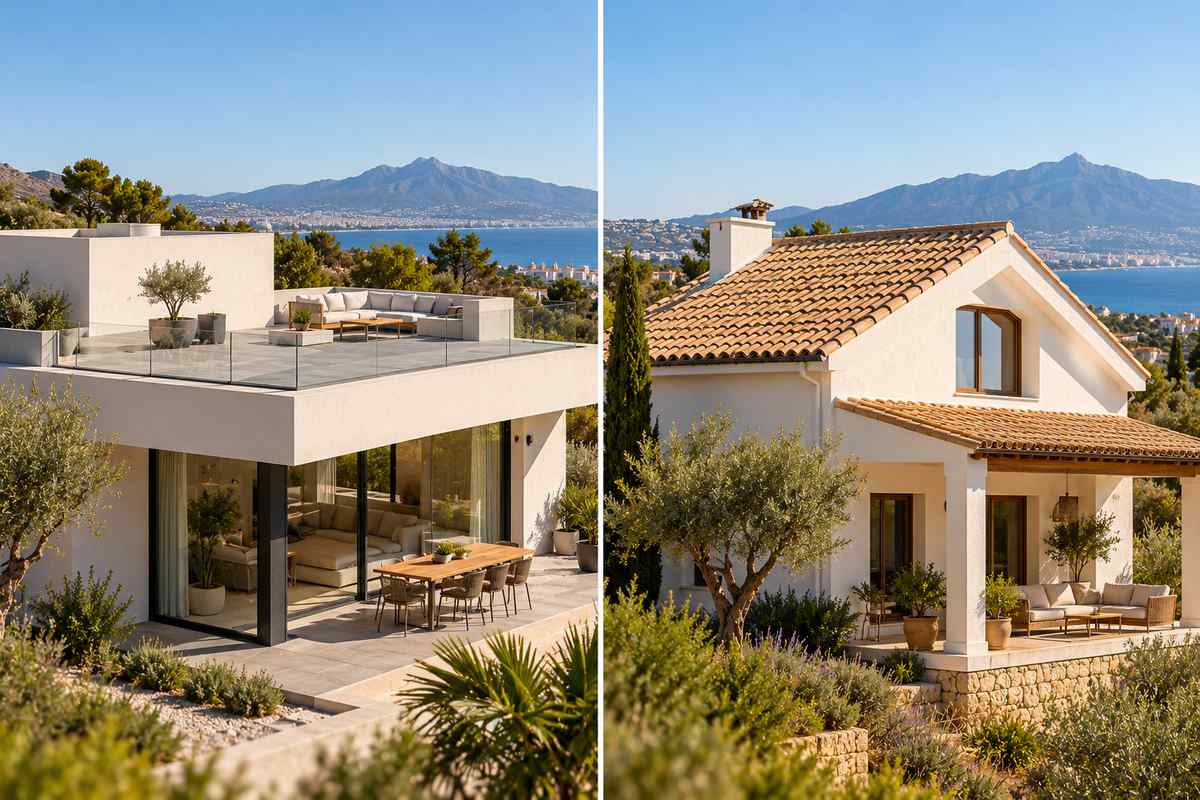
The roof — the “fifth façade” of any building — is one of the most important structural decisions in a residential project on the Costa del Sol. A flat roof offers an accessible terrace or space for building services, sits more naturally with today’s Mediterranean aesthetic and is the usual choice in minimalist architecture. A pitched roof sheds water more easily in areas with heavy rainfall, has greater thermal inertia and can accommodate a loft floor beneath it. Neither is universally better: the right choice depends on the planning rules, the local climate, the intended use and the architectural style of the project.
Flat roofs: advantages, drawbacks and when they are the right choice
The flat roof — in reality slightly sloped (1-3%) to drain water — dominates modern residential architecture on the Costa del Sol. Its advantages in this climate are clear:
• Accessible terrace: the entire upper surface becomes usable living or leisure space. In Marbella, a flat roof with sea views can be a home’s most valuable asset.
• Building services: a flat surface makes it easy to install solar panels, air-conditioning units and water tanks.
• Aesthetics: it fits perfectly with contemporary Mediterranean style and clean-lined architecture.
• Construction cost: usually somewhat cheaper than a pitched roof of the same quality.
Its two main drawbacks are maintaining the waterproofing (it needs inspecting every 10-15 years, and any damage must be repaired before it causes a leak) and greater heat absorption in summer if it is not properly insulated. On the Costa del Sol, a flat roof without sufficient insulation can raise the temperature of the top floor by 4 to 8 degrees.
Klic Arquitectos’ standard specification for flat roofs in residential projects includes: a two-layer waterproofing membrane with puncture-resistant protection, 8-10 cm of XPS (extruded polystyrene) insulation, a protective layer and a finish (gravel, tiles or composite decking for accessible terraces). A well-resolved roof detail saves years of problems.
Pitched roofs: when they make sense in Málaga
The pitched roof — Spanish barrel tiles, flat tiles or sandwich panels with metal cladding — is less common in contemporary Costa del Sol architecture, but it is still necessary in certain contexts:
• Areas with heavy rainfall: inland in the province of Málaga (Ronda, the Axarquía, the sierras), wind-driven rain or snow mean a pitched roof sheds water far more effectively.
• Planning rules: some municipalities or specific residential estates require pitched roofs to keep the surroundings visually consistent. Before designing anything, the local General Urban Development Plan (PGOU) must be checked.
• Habitable loft space: a well-designed pitched roof can create a usable space (an attic room, a studio, storage) that adds floor area without increasing the building’s footprint.
• Less long-term maintenance: good-quality ceramic tiles last 40-60 years without significant work, compared with 15-20 years for the waterproofing on a flat roof.
Its main drawback is constructional: a pitched roof needs a larger area of roofing material (because of the slope) and more complex junctions (eaves, hips, valleys), and in designs with multiple roof slopes it can push up construction costs by 15-25% compared with a flat roof of the same area.
Cost comparison: flat vs pitched roofs on the Costa del Sol (2026)
Prices vary significantly depending on the system and the quality of the finish. Indicative prices for residential properties on the Costa del Sol (excluding VAT, installed):
• Non-accessible flat roof (waterproofing + insulation + gravel): €60-100/m²
• Accessible flat roof (complete system + tile or decking finish): €120-200/m²
• Planted flat roof (green roof): €180-350/m²
• Pitched roof with Spanish barrel tiles or other ceramic tiles (structure + roof deck + tiles): €90-140/m² of roof surface
• Pitched roof in zinc or copper (premium finish): €180-300/m²
Important note: the price per m² of a pitched roof is calculated on the actual surface of the roof slope, not on the plan area. On a gable roof with a 30° pitch, the roof surface is roughly 15% larger than the plan area.
What the planning rules may decide for you
In many Costa del Sol municipalities, the choice between a flat and a pitched roof is not entirely free. The General Urban Development Plan (PGOU) or the regulations of certain residential estates may set:
• A mandatory roof type (flat, pitched or both permitted).
• Minimum and maximum slopes for pitched roofs.
• Permitted materials (tiles, zinc, green roof).
• Maximum ridge height (which may rule out a habitable loft).
At Klic Arquitectos we always review the applicable planning regulations before proposing any roofing solution, because a roof that does not comply with them can become an obstacle to obtaining the building permit or to selling the home in the future.
Frequently asked questions about flat and pitched roofs
Which roof is best suited to the Costa del Sol climate?
Along the Costa del Sol coastline, a flat roof with good waterproofing and insulation is the most common and practical option. Rainfall is moderate (500-700 mm a year) and concentrated in autumn and winter, so a well-built flat roof handles water without any problems. A pitched roof makes more sense inland in the province, where there is more rain and a greater risk of water building up.
How long does the waterproofing on a flat roof last?
A correctly installed two-layer waterproofing system with high-quality modified bitumen membranes has a service life of 15-25 years. High-end PVC or TPO membranes can last up to 30-40 years. The key lies in the quality of the material, the execution of the details (drains, upstands against walls, parapets) and regular inspection every 3-5 years to spot blisters or tears before they cause leaks.
Can I convert a pitched roof into a flat roof, or vice versa?
Yes, but it requires a project drawn up by an architect and a building permit. The change involves altering the roof structure, which is major building work. In addition, if the current roof complies with the planning rules but the new roof type is not permitted in that area, the change may not be feasible. A preliminary study by an architect is essential before considering it.
Can solar panels be installed on a pitched roof?
Yes. In fact, a south-facing pitched roof with a slope of 30-40° is the optimal solution for installing photovoltaic or solar thermal panels in Andalusia, because that angle maximises solar gain. It is also possible on a flat roof, but tilted mounting frames are needed, which add cost and complexity.
Does Klic Arquitectos design and build roofs as part of full renovations?
Yes. In the full renovation and turnkey construction projects we carry out on the Costa del Sol, the roof — together with the structure and the building services — is one of the elements we supervise most closely. We guarantee the right construction solution for each project, the choice of the optimal waterproofing and insulation system, and leak-free execution.
Do you have a construction or renovation project on the Costa del Sol?
At Klic Arquitectos we define the most suitable roofing solution for each project, complying with planning regulations and ensuring maximum durability and energy efficiency. Get in touch with no obligation.
→ www.klicarquitectos.com