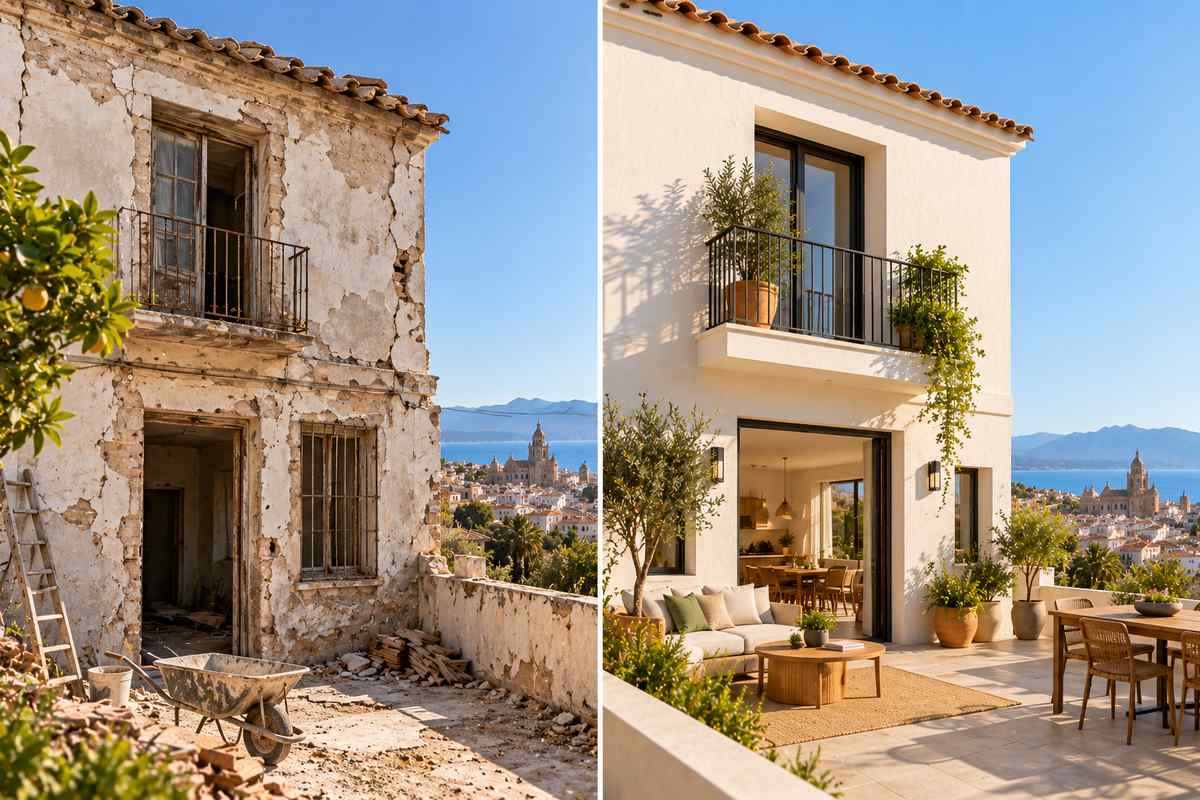
Renovating an old home in Málaga — whether it is a 1960s flat in the historic centre, a village house inland or a 1970s coastal apartment — is a project of a different order of complexity from renovating a recent property. It is not “the same thing, only slower”: it is a kind of work that calls for an initial diagnosis, technical judgement and planning that goes far beyond choosing tiles and paint. Done well, it can turn a home that has lost value into one of the most sought-after properties in its area.
Why old homes have problems that new ones don’t
A home built in Málaga before 1990 has, by definition, a number of features that complicate (and sometimes increase the cost of) a renovation:
• Outdated electrical installation: no earthing, cable cross-sections unsuited to today’s power demands and a consumer unit with no RCD. The current Spanish Low Voltage Electrotechnical Regulation (REBT 2002) requires everything to be brought up to standard in a full renovation.
• Lead or galvanised iron plumbing: pipes that degrade water quality and suffer from chronic leaks. Complete renewal of the hot and cold water installation is essential.
• No thermal insulation: homes built before 1980 were constructed with no insulation requirements whatsoever. A renovation that does not tackle insulation will let in the cold in winter and the heat in summer just as before.
• Outdated layout: small, closed-off kitchens, a single bathroom, narrow corridors. Opening up the layout often means altering load-bearing walls or rerouting services.
• Long-standing damp and leaks: deteriorated roofs, façades and window frames that have caused damp problems which must be remedied before work begins.
How much does it cost to renovate an old home in Málaga? Real price ranges in 2026
The cost of a full renovation of an old home on the Costa del Sol depends on the floor area, the condition of the property and the level of quality chosen. Klic Arquitectos’ ranges for 2026:
• Basic full renovation (complete renewal with no change of layout, standard finishes): €600–900/m²
• Mid-range full renovation (partial change of layout, quality materials, complete kitchen and bathrooms): €900–1,400/m²
• High-end full renovation (complete redesign of the layout, premium materials, home automation, designer kitchen): €1,400–2,200/m²
Worked example: an 80 m² flat built in the 1970s in Torremolinos that needs a top-to-bottom full renovation (all-new services, new layout, new kitchen and two new bathrooms, new exterior windows and doors, flooring and paintwork) will have a construction cost of between €72,000 and €110,000, plus technical fees and permits (an additional 10–15%).
The initial diagnosis: the step almost nobody takes and the one that saves the most money
Before hiring anyone and before asking for a single quote, an old home should undergo a technical diagnosis that identifies:
• Condition of the structure: floor slabs, beams, columns and load-bearing walls.
• Existing services: layout, condition and capacity of the electrical, plumbing and drainage installations.
• Presence of damp: its source (water ingress, rising damp, condensation) and extent.
• Condition of the roof and exterior joinery: whether they need complete replacement or repair.
This diagnosis, carried out by a building engineer (arquitecto técnico) or by the Klic Arquitectos team during the preliminary study phase, costs between €300 and €800, but it can identify problems which, if not detected before work starts, would surface in the middle of the renovation and multiply both cost and timescale.
The right sequence for a full renovation of an old home
The order of works in a full renovation of an old home is not optional: getting it wrong leads to costly rework. The standard sequence:
1. Demolition and strip-out: removal of partition walls, floor finishes, wall coverings and any elements to be replaced.
2. Damp remediation and structural reinforcement where needed.
3. Main building work: changes to the layout, new openings, new walls.
4. Concealed services: horizontal drainage, embedded water pipes, chases for electrical wiring.
5. Building envelope and roof (where needed): new windows, waterproofing.
6. Finishes: wall tiling, flooring, plastering and wall linings.
7. Visible services: switches and sockets, taps, radiators, split air-conditioning units.
8. Interior joinery, kitchen and bathrooms.
9. Painting and final finishes.
The real value of renovating well: return on investment and quality of life
In the Costa del Sol property market, a well-renovated old home can reach a market value between 40% and 80% higher than its price before the renovation. In prime areas such as Málaga’s historic centre, or in coastal towns with high demand for holiday rentals (Marbella, Benalmádena, Torremolinos), the full renovation of an old home can deliver a project return of 15–30% on the total investment.
But beyond the investment, a well-executed renovation of an old home transforms everyday life: thermal comfort, quietness, natural light and the functionality of the spaces are qualitatively different before and after. It is the kind of transformation that, when we carry it out at Klic Arquitectos, leads clients to say it is “nothing like it was before”.
Frequently asked questions about full renovations in Málaga
How long does a full renovation of an old home take?
Between 3 and 6 months for a 60–100 m² flat, from the start of works to handover. If a major works permit is required (structural changes or significant changes to the layout), you need to add 2–6 months of processing before work can begin. For a full renovation with no structural changes, a minor works permit can be obtained in 3–6 weeks.
When is it worth renovating rather than buying new?
Renovating is usually a better option than buying new when: the old home is in a very good location (beachfront, historic centre, high-demand area), the purchase price plus the renovation comes in below the market price of an equivalent new-build home in the same area, or when the design of the old home has features that new ones do not offer (high ceilings, generous floor area, a large terrace).
Can you live in the home during the renovation?
In full renovations that include renewing services and changing the layout, living in the home while the work is under way is practically unfeasible. The dust, the noise, the lack of water and electricity at various stages and the health risks all mean that the advisable course is to move out for the duration of the works. In partial renovations (kitchen only, bathrooms only), it is possible to live alongside the works.
What does a turnkey full renovation by Klic Arquitectos include?
Architectural design, permit management, execution of the complete works (structure, services, finishes, joinery) and technical supervision, all under a single contract at a single fixed price. The client does not have to coordinate any trades or administrative agents: the home is handed over finished and ready to live in within the agreed timeframe.