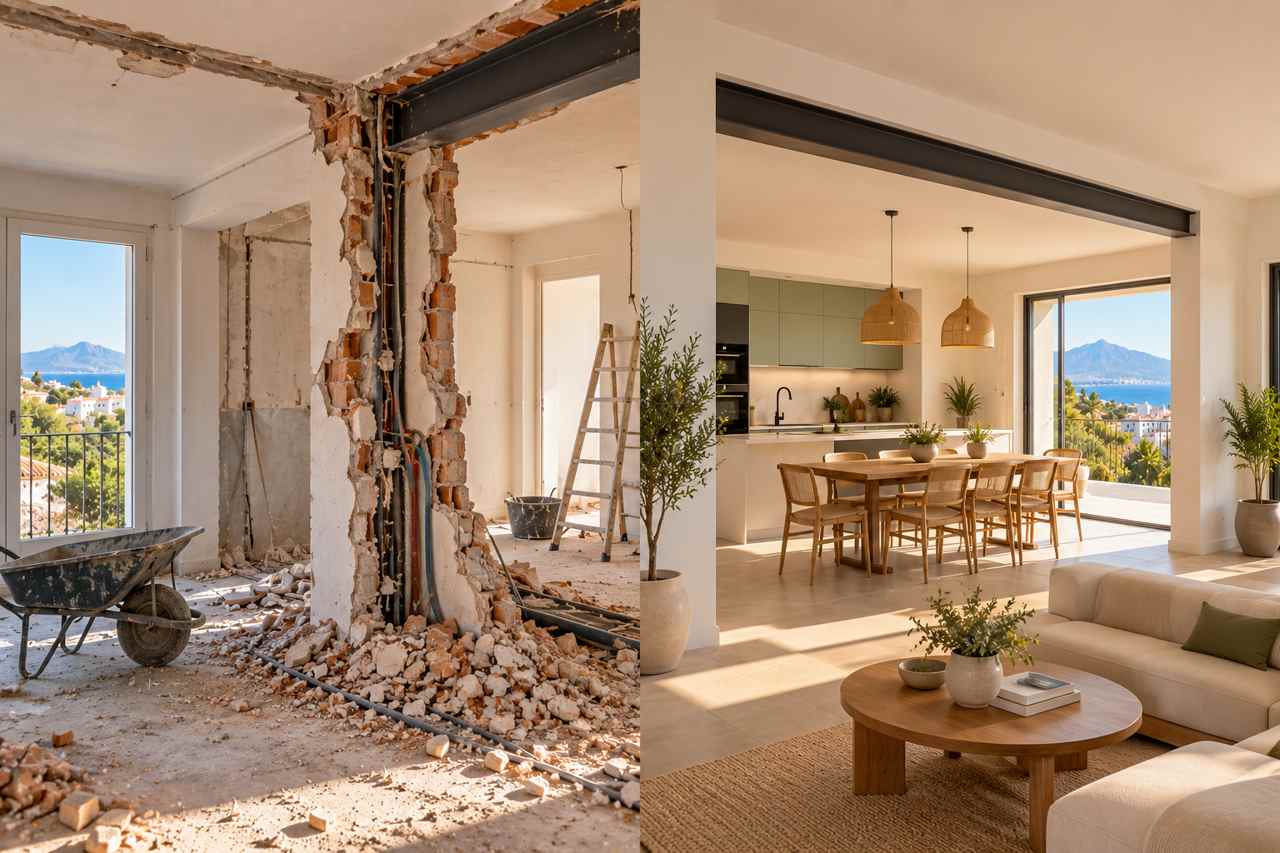
On the Costa del Sol in 2026, knocking down a wall costs between €300 and €2,500, depending on whether it is a partition or a load-bearing wall, its length, debris removal and the finishing work afterwards. But the demolition itself is only one part of the real budget: the services affected (electrics, plumbing, air conditioning), structural reinforcement where needed and making good the floors, ceilings and walls can double or even triple the final cost. Here is what you need to know to avoid any nasty surprises.
Partition or load-bearing wall: the first question to ask yourself
Before any wall is touched, an architect needs to determine whether it is a partition (a dividing wall with no structural function) or a load-bearing wall (one that carries the weight of the floors above or the roof). This distinction completely changes the complexity and cost of the work.
Non-structural partition:
• Typical materials: hollow brick, plasterboard, gypsum block.
• Can be taken down without an exhaustive prior survey of the structure.
• Demolition cost (excluding debris removal and finishes): €15–40/m² of wall.
• Requires a minor works permit in most municipalities.
Load-bearing wall:
• Typical materials: solid brick, concrete block, reinforced concrete.
• Requires a structural survey and a project drawn up by an architect before any work begins.
• Needs a replacement element (a steel or concrete beam, or a portal frame) to redistribute the loads.
• Total cost (demolition + beam + finishes): €2,000–8,000 depending on length and load.
• Requires a major works permit in most cases.
How to spot a load-bearing wall without being an architect: if the wall runs perpendicular to the floor beams, continues vertically on the floors above, sits in the middle of the home (a central spine wall) or is more than 20 cm thick, there is a good chance it is load-bearing. The only way to be sure is a technical survey.
Detailed prices: how much does it cost to knock down a wall in Málaga (2026)
The following costs are a guide for work on the Costa del Sol, including labour but excluding VAT and permits:
• Demolition of a hollow-brick partition (~10 cm, 10 m²): €200–400
• Demolition of a plasterboard partition (10 m²): €150–300
• Demolition of a solid-brick wall (load-bearing, 10 m²): €400–700
• HEB steel beam for a 3 m opening (supply + installation): €800–1,800
• Debris removal (skip + transport): €200–500
• Reinstating finishes (paint, floor, ceiling) in the affected area: €300–1,000
A common case in full renovations on the Costa del Sol: joining the living room and kitchen by removing a 4 m partition. Indicative all-in budget (demolition + debris removal + opening for an open-plan kitchen + finishes): €1,200–2,500.
What permit do I need to knock down a wall?
In most municipalities on the Costa del Sol (Marbella, Torremolinos, Mijas, Benalmádena, Fuengirola), knocking down a wall (even a simple partition) requires at least a minor works permit. Without one, the work can be stopped and the owner may be fined.
• Minor works permit (non-structural partitions): processed in 2–4 weeks, with a municipal fee of 1–3% of the construction budget.
• Major works permit (load-bearing walls or renovations that change the overall layout): requires a project drawn up by an architect and can take 2–6 months.
In buildings with a community of owners, as well as the Town Hall permit, you may also need the community’s consent if the wall affects communal elements or the building’s structure.
What nobody tells you: the hidden services inside the wall
Walls, especially in homes built between the 1970s and 2000, often conceal undocumented services: electrical cables, water or gas pipes, soil stacks and, in some cases, air-conditioning or ventilation ducts. Before demolishing, it is essential to:
1. Cut off the supplies at the consumer unit (electricity) and the stopcocks (water, gas).
2. Use a cable and pipe detector or make exploratory openings.
3. Reroute the affected services before demolishing, not afterwards.
In full renovations where Klic Arquitectos coordinates all the work, this preliminary services survey is part of our standard protocol. In one-off jobs without an architect, many owners discover that the wall contained a soil stack that now has to be rerouted: an extra cost that can exceed that of the demolition itself.
Frequently asked questions about knocking down walls in renovations
How can I tell if my wall is load-bearing before calling an architect?
Warning signs: more than 20 cm thick, perpendicular to the floor beams, continuing on the floors above or, on the ground floor, sitting directly on the foundations. If you see any of these signs, treat the wall as load-bearing until a professional confirms otherwise. The cost of a preliminary survey (€150–400) is infinitely lower than that of a structural mistake.
How long does it take to knock down a wall?
Demolishing a standard 10 m² partition takes half a day. If a structural beam has to be installed, the work extends to 2–5 days (including temporary propping, beam installation and sealing). The finishing work afterwards adds another 2–4 days, depending on the area to be treated.
Do I need to empty my home to knock down a wall?
For partitions with no services inside, you do not have to empty the whole home, but you should protect the furniture and seal off the work area with plastic sheeting. For load-bearing walls that require propping, the work generates a lot of dust and vibration, so it is advisable for the home to be unoccupied during the demolition and beam installation phase.
Does Klic Arquitectos handle this kind of small job?
Yes, when it is part of a larger full renovation. For one-off partition removals, we can advise you and, if the project warrants it, carry out the technical survey and site management. Our main focus is full renovations and turnkey projects on the Costa del Sol.