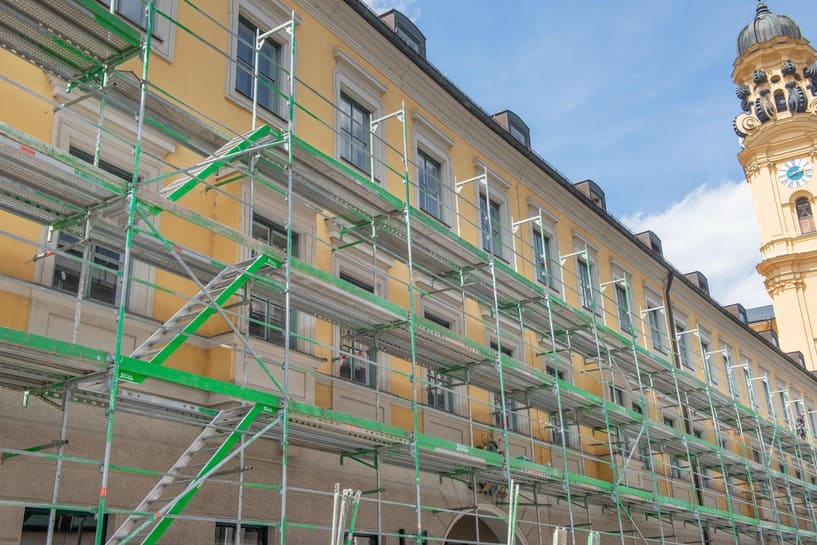
What to consider in facade refurbishment: everything worth knowing before the scaffolding goes up.
The facade is the part of a building that ages fastest. It takes the weather, the sun and, on the coast, salt-laden air year after year. That is why seafront buildings in Torremolinos tend to need attention sooner than inland ones. Materials wear out, so the facade needs maintenance to keep both its function and its appearance.
In this post, Klic Arquitectos explains why facade refurbishment matters and what to weigh up before committing to the work.
Facade refurbishment: why does it matter?
Facades on houses and blocks of flats take more punishment than any other element. The materials wear with time and with exposure to the climate. The damage shows up as cracks, blown render and damp patches. Beyond making the building look neglected, that can put people on the pavement at risk and turn into structural problems inside the flats.
Keeping the facade in good order is what keeps the rest of the building sound. These are the main reasons facade refurbishment is worth doing properly:
It prevents accidents
Inside and out, the facade protects the structure. In poor condition it sheds material, and a piece of render coming off a balcony is enough to injure someone on the pavement. In Spain that liability sits with the owners’ association (comunidad de propietarios), and the town hall can issue an enforcement order (orden de ejecución) requiring the repair to be carried out.
It changes how the building looks
Renewing the exterior is what makes the first impression. On a block that is being sold or let, it is often the difference between a viewing and a walk-past.
It adds value
Like any refurbishment, work to the facade raises the market value of the building. It also removes a defect that any surveyor would otherwise write up.
It is the moment for technical improvements
This is not only about patching damage. It is the one point in a building’s life when you can insulate it properly and improve its energy performance. Better thermal insulation brings better acoustic insulation with it, which is welcome near a busy road or a beach bar.
What should you consider when refurbishing a facade?
The facade, then, carries real weight in the refurbishment of a building, so the planning stage deserves attention. These are the points not to skip:
The rules that apply
Before starting work of this kind, find out what the local rules require. Not every repair, and not every type of facade, needs the same licence. In Spain the scale of the work decides whether a notification to the town hall (declaración responsable) is enough or whether you need full planning permission (licencia de obras), and a facade with heritage protection changes the answer again. Each town hall applies this its own way: Málaga, Torremolinos and Benalmádena are not interchangeable. Older buildings also face a periodic structural inspection (Inspección Técnica de Edificios, or ITE), with the qualifying age set by each municipality. Settle all of this before the design is finished, not after.
An initial diagnosis of the facade
A diagnosis by an architect is the basic step, and it comes first. You cannot specify a repair for damage you have not identified. Cracking from thermal movement, corroding reinforcement and rising damp look much the same from the street and need entirely different work. The diagnosis defines what the facade needs, and that in turn defines the project and the budget.
Choosing the refurbishment system
There are several facade systems, and they go well beyond repainting the outside of the building. This is where the energy gain comes in, through insulation applied to the outside of the wall.
Among the systems available today, SATE (Sistemas de Aislamiento Térmico Exterior, external wall insulation) has become one of the best regarded for how well it works. It is not the right answer everywhere: it adds thickness and changes the appearance of the wall, so on a protected facade or a tight boundary it may be ruled out from the start.
Working with professionals
Given what is at stake, this is work for a team that has done it before: an architect for the diagnosis and the project, a technical architect (aparejador) supervising execution on site, and a contractor with facades on its record. At Klic Arquitectos we take on facade refurbishment and refurbishment work in Málaga. If you are weighing up a facade on a building here, a diagnosis is the sensible first step. It will also tell you honestly whether it can wait a couple more years.