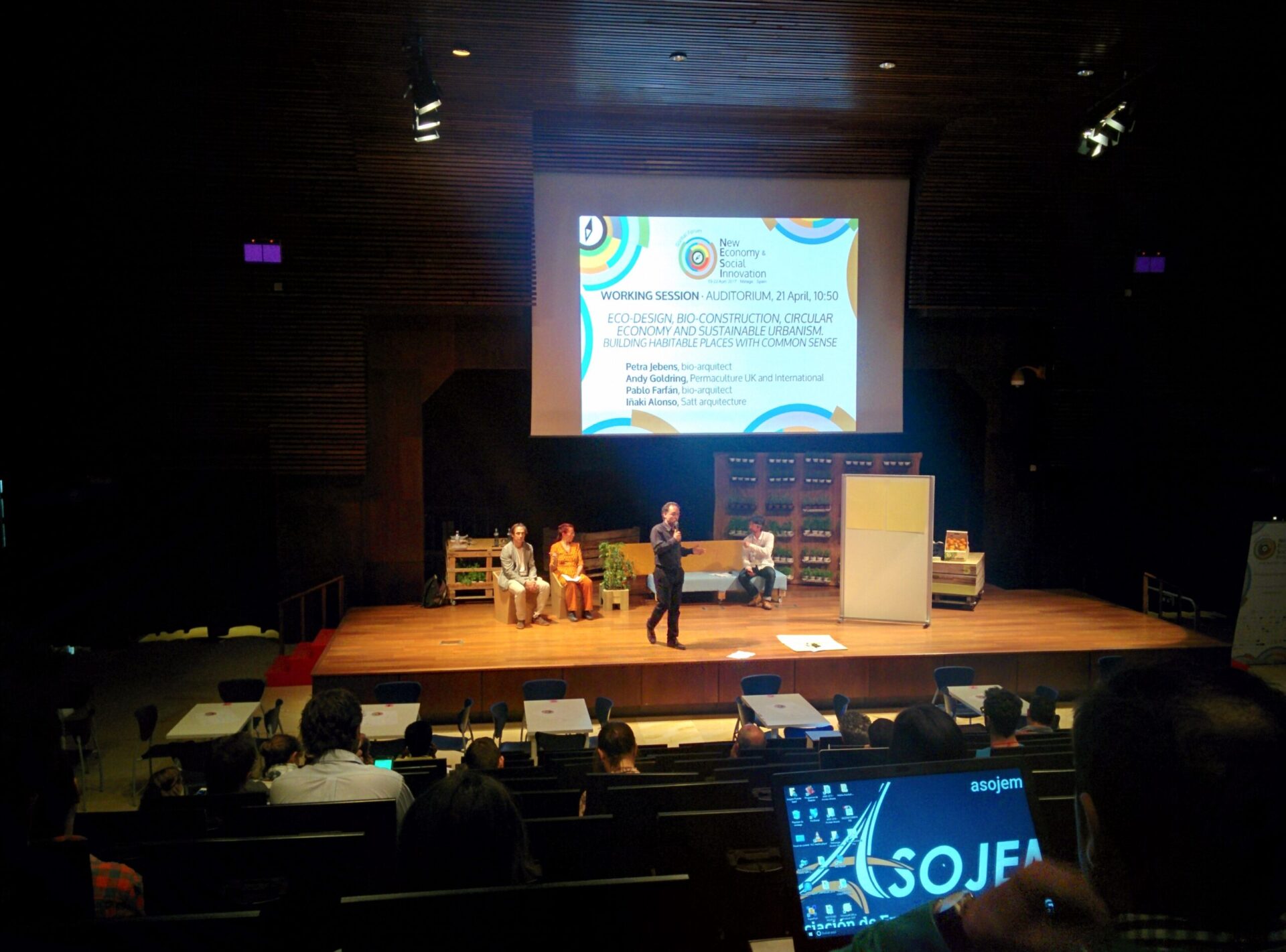
Last Friday we spent the day at the Palacio de Congresos in Málaga, at the NESI Forum 2017 — the New Economy and Social Innovation gathering (Nueva Economía e Innovación Social) that came to our own city.
The forum is a space for debate on new models of social and economic development, and it brought together international speakers from very different fields: economics, farming, architecture, health, communications and politics.
Our interest sat squarely in the Friday programme on architecture and sustainable urban planning. We began with the working session “Building Liveable Places with Common Sense” (Construir Lugares Habitables con Sentido Común), on eco-design, bio-construction, the circular economy and sustainable planning. Andy Goldring (ENG), Petra Jebens-Zirkel (GER), Iñaki Alonso (ESP) and Pablo Farfán (ESP) each set out the thinking behind their work. Two stood out for us: Iñaki Alonso, of the SATT practice, on his experience setting up cohousing schemes; and Pablo Farfán, on the use of low-carbon materials.
From there we joined the round table “Developing an economic model for bio-construction” (Desarrollo de un modelo económico para la Bio-construcción). Most of the people around it work in construction, and the conversation kept returning to two problems: how little these building techniques travel beyond the specialists, and how little information reaches clients. The group’s conclusion was that the sector needs a platform to explain what bio-construction is good for, and proper training for the technical professionals who have to specify it.
The term is worth a word of explanation, because it does not map neatly onto English usage: bioconstrucción is closest to what Britain would call natural or low-impact building. It means using materials that are gentler on the environment and, above all, gentler on the people who live with them, while paying attention to what happens on site and to the environmental cost of the building process itself. That thinking has to run through every stage, from design right through to the build. And as architects we have a central role in explaining to clients what they actually gain by building this way.
Red Verde, one of the main suppliers in the province, explains the concept here: www.redverde.es/que_es_bioconstruccion
We closed the day at the #NESI Territorio talks and at “Sharing economy for the elderly: social transport”. A good note to finish on.