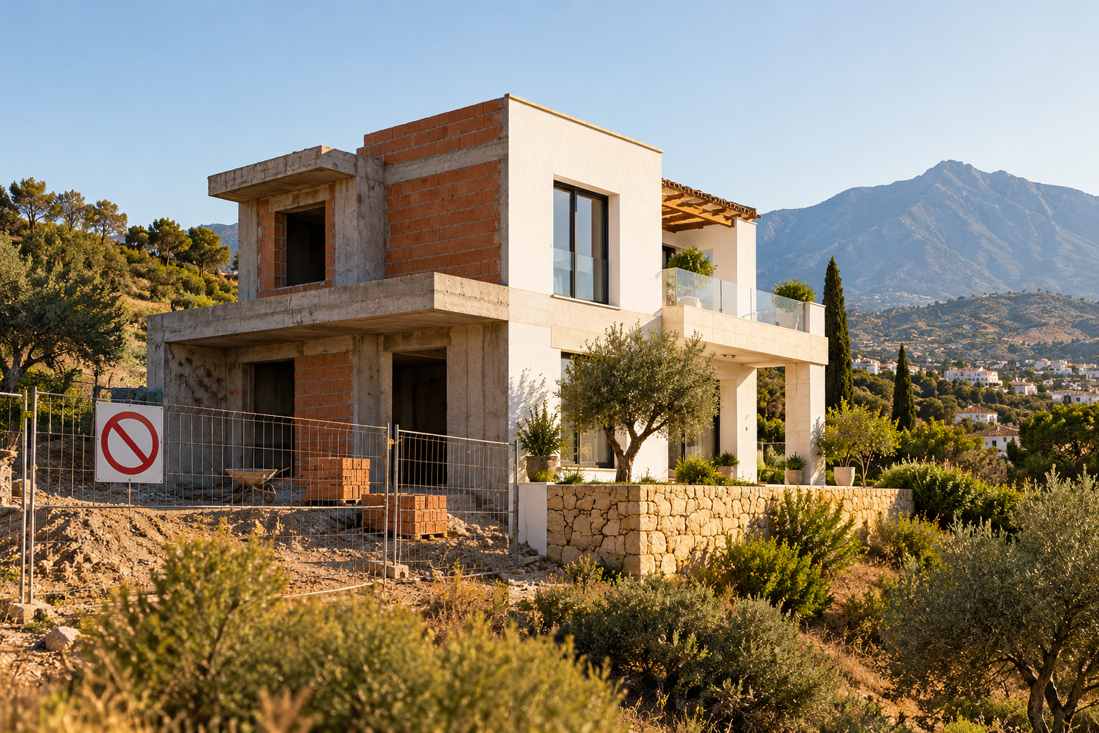
An illegal house in Andalusia is one that has been built without a licence or that, despite having one, has breached its conditions — exceeding the permitted height, adding more square metres than authorised or building on land not suitable for residential construction. Demolition of an illegal building is not automatic: Andalusia has a statute of limitations for planning breaches which, under certain conditions, means an illegal building can be classed as “assimilated to the outside-planning regime” (ARFO, asimilado al régimen de fuera de ordenación). This status protects it from demolition but restricts its future use.
If you own — or are thinking of buying — a home with legal issues on the Costa del Sol, this article explains what you need to know.
When is a building illegal in Andalusia?
A building is illegal when it has been built in any of the following circumstances:
• Without any kind of planning or building licence.
• With an expired licence (the works were finished long after the planned date without an extension).
• In breach of the conditions of the licence granted (more height, more square metres, more homes).
• On non-developable land without special authorisation (the most serious case).
• In public domain areas (coastline, watercourses, roads).
Important: having a notarised title deed, being registered with the Cadastre (Catastro) or even paying IBI (property tax) does not regularise an illegal building. These systems are independent of planning law.
Can you be forced to demolish your house? The limitation period in Andalusia
In Andalusia, the LOUA (Andalusian Planning Act) sets a limitation period of 6 years for planning breaches. Once this period has elapsed without the authorities having opened proceedings to restore planning legality, the building falls into ARFO status (assimilated to the outside-planning regime).
What ARFO means in practice:
• The authorities cannot order its demolition.
• You can obtain utility connections (water and electricity) and register the house with the Property Registry.
• You cannot obtain a licence for extensions or any significant new works.
• The property can be sold, but the buyer must be aware of its status — the title deed must state its ARFO status.
• If the building suffers serious damage (fire, partial collapse), it cannot be rebuilt.
Critical exception: buildings on specially protected non-developable land (protected coastal areas, natural parks, riverbeds, the maritime-terrestrial public domain) are NEVER time-barred. The authorities can order their demolition at any time, even after 30 years.
The demolition process for an illegal house: how it works
When the authorities detect an illegal building (through a neighbour’s complaint, a review of aerial photographs, a site inspection or a cadastral regularisation), they can open proceedings to restore planning legality (Expediente de Reposición de la Legalidad Urbanística). In simplified form, the process is:
1. Opening of proceedings: the authorities notify the owner of a suspected planning breach.
2. Hearing: the owner can submit objections and documents and, where possible, apply for legalisation.
3. Decision: if legalisation is not viable, a demolition order is issued.
4. Enforcement: if the owner does not demolish voluntarily within the stated period, the authorities can carry out the demolition themselves and charge the cost to the owner.
The cost of demolishing a 100-150 m² detached house on the Costa del Sol ranges from €15,000 to €40,000, depending on the technique (manual demolition vs machinery), the waste to be managed and how difficult the site is to access.
Can an illegal building be legalised in Andalusia?
Yes, but only if the use and parameters of the building are compatible with the planning rules in force. The process is called a Legalisation Licence (or “building licence for regularisation”) and requires:
• A technical design (proyecto técnico) signed by an architect certifying that the existing building complies with the applicable regulations.
• Payment of the municipal fees for the works carried out.
• In some municipalities, an additional fine for the planning breach.
If the building cannot be legalised (for example, because it has more square metres than the planning rules allow), the owner has two options: adapt it (by demolishing the illegal part) or apply for ARFO status if more than 6 years have passed without action by the authorities.
What to do if you are buying a home that may have legal issues
On the Costa del Sol, particularly on 1970s and 1980s urbanisations in Marbella, Mijas or Benalmádena, it is relatively common to find homes with some kind of irregularity (porches enclosed without a licence, undeclared extensions, storerooms converted into bedrooms). Before signing any purchase contract:
• Request a nota simple (land registry extract) from the Property Registry and compare the registered floor area with the cadastral and actual area.
• Ask the Town Hall for the plot’s planning information sheet and its history of licences granted.
• Hire an architect to prepare a planning legality report before signing.
• If there are irregularities, renegotiate the price or require the seller to regularise them before completion.
Frequently asked questions about illegal houses in Andalusia
Can I sell a house with ARFO status?
Yes. A home with ARFO status can be bought and sold. The notary is required to record the property’s planning status in the title deed. The buyer must know what they are buying: a house that exists legally but cannot be extended and, if destroyed, cannot be rebuilt.
Do illegal houses built on non-developable land become time-barred?
It depends on the type of land. On ordinary non-developable land, the limitation period is 6 years (ARFO). On specially protected non-developable land (protected coastline, natural parks, riverbanks), breaches are never time-barred: the authorities can order demolition at any time.
How much does it cost to demolish an illegal house?
Between €15,000 and €40,000 for a 100-150 m² detached house on the Costa del Sol, including waste management and permits. If the authorities carry out the demolition themselves, the cost is passed on to the owner and can be significantly higher because of administrative costs.
Can Klic Arquitectos help me legalise an existing building?
Yes. We prepare planning legality reports and legalisation projects, and handle applications with the town halls of the Costa del Sol. If legalisation is not possible, we advise on the alternatives (ARFO, partial adaptation) and the implications of each option.
What happens if the Town Hall orders me to demolish but I don’t want to?
You can challenge the decision through administrative channels (an appeal to a higher authority or a request for reconsideration) and, if that fails, before the administrative courts. A planning lawyer and an architect experienced in urban planning are essential in that process. However, if the decision is final and enforceable, the Town Hall can carry out the demolition itself and recover the cost from the owner.
Unsure whether your home on the Costa del Sol is legal?
Klic Arquitectos prepares planning legality reports for owners and buyers throughout the Costa del Sol. If you are in the process of buying or have doubts about your current home, contact our team for an initial consultation.
→ Talk to our architects: www.klicarquitectos.com