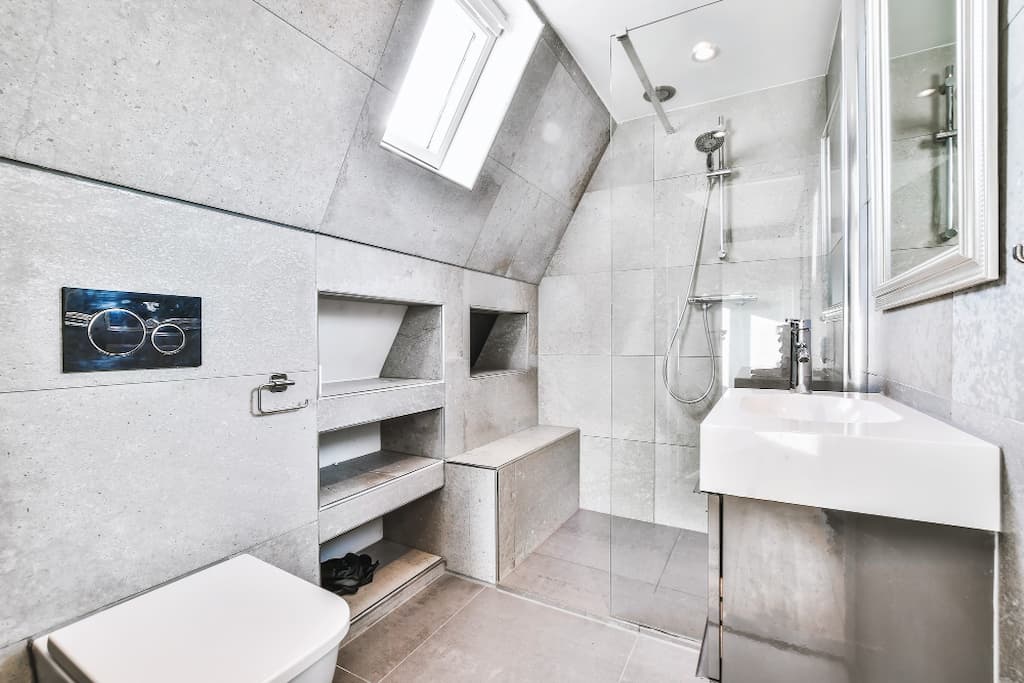
The bathroom is the smallest room in the house and the one that goes wrong most often. It is also where most owners on the Costa del Sol start. The job is contained, and quick compared with taking on a whole flat. And it changes how a property feels — and what a buyer will pay for it — more than any other single room.
This guide covers how to refurbish a bathroom in Spain without getting caught out: the paperwork, the materials that survive a coastal climate, which trends are worth paying for, and the five stages of the work in order. On higher-end jobs, owners often bring an architect in early. That is a large part of what we do as architects in Marbella and across Málaga province. Plenty of bathrooms do not need one, though, and we will say where the line falls.
Why a bathroom refurbishment changes more than you expect
A bathroom is not only a question of appearance. It is the room with the most services packed into the fewest square metres. That is why poor decisions show up here fastest: damp, a shower that never quite drains, a socket in the wrong place for the rest of the property’s life.
Done properly, it improves how the home works day to day and it lifts what the property is worth. That matters if you are also weighing up bigger works, such as villa refurbishments. Modest update or full strip-out, the detail is the job.
Planning: work out what you need before you fix the budget
Start with the brief, not the mood board. Do you need more storage, a better layout, a walk-in shower instead of a bath? Or simply finishes that are not twenty years old? A realistic budget set at the outset is what lets you prioritise later, when the tiler shows you something at twice the price of what you specified.
For an order of magnitude: a full refurbishment in Málaga runs €800–1,600/m², depending on specification. A bathroom sits at the top of that band, because it concentrates more plumbing, electrics and waterproofing into fewer metres than any other room. A quote well below it is either leaving something out or planning to find it later.
Planning properly is also how you avoid the two classics: cost overruns and delays. Look at real reference projects. Compare material prices. Get a professional opinion before anything is ordered. Method is dull, and it works.
One honest caveat. If the budget is tight and the layout already works, do not move the sanitaryware. Shifting a WC or a soil connection turns a straightforward job into a structural one. The money then goes on trades and time rather than on anything you can see afterwards.
Current trends in bathroom design
Bathrooms have changed a great deal, in layout as much as in looks. The prevailing ideas run from restrained minimalism to natural and high-end finishes:
- Minimal, functional design: neutral colours — white, grey, beige — with wall-hung units that free up floor area and make cleaning far easier.
- Integrated technology: smart taps, LED-lit mirrors and thermostatic showers are becoming standard rather than special. Worth remembering that anything you specify can fail. Buy from brands with spares available in Spain, not from a website you will never find again.
- Sustainable materials: certified timber, recycled tiles and water-saving fittings. On the Costa del Sol, where water restrictions are a recurring feature of the summer, flow-limited fittings are pragmatic rather than merely virtuous.
Look at what has been built locally rather than at international magazines. The solutions that work in a Torremolinos flat with one small window are not the ones photographed in a northern European show home.
Materials that last in a coastal climate
Material choice decides how long the bathroom lasts as well as how it looks. Everything in the room has to cope with humidity and daily use. Near the coast it also has to cope with salt-laden air and hard water.
- Tiles and wall finishes: porcelain stoneware (gres porcelánico) is the workhorse, for its resistance. Ceramic tiles give more choice of pattern and price.
- Water-resistant furniture: lacquered units, or units finished with waterproof varnishes. Moisture-resistant MDF (MDF hidrófugo) is a sound choice. Insist on it if the property is a second home, shut up for months at a time.
- Worktops: marble and granite give the room weight and quality. Engineered quartz and resin surfaces cost less and take limescale better — a real consideration with the water hardness along this coast.
Natural finishes are what the trends point to. It is worth putting the same attention into the parts nobody photographs: the tanking, the falls in the shower tray, the extractor.
The five stages of a bathroom refurbishment
A bathroom refurbishment feels unmanageable until you break it into stages. Here is the sequence a good contractor follows, and what you should be checking at each point.
Design and permissions: the paperwork comes first
Before anyone lifts a hammer, settle the design: the layout, the materials, the position of every socket and light. Then deal with the permissions, because Spain does not work the way the UK does.
A bathroom that stays put, keeps its walls and touches neither the structure nor the façade counts as minor work. Under Andalusia’s planning act (Ley 7/2021, known as LISTA) that goes through as a declaración responsable: a declaration you file and pay for and can then start on, rather than a licence you queue for. Málaga, Torremolinos and Benalmádena all handle it that way.
Move a soil pipe, take a wall down, change a window or touch anything structural, and it becomes a full works licence (licencia de obras). That means a technical project signed by an architect. It also means satisfying Spain’s building regulations (Código Técnico de la Edificación, CTE) on ventilation and waterproofing.
Two things overseas owners routinely miss. First, if you are in a block, the soil and waste stacks (bajantes) are common property under the Horizontal Property Act (Ley de Propiedad Horizontal). You cannot reroute them at will, and the community of owners has to be told before work starts.
Second, tax. For a private owner, work on a dwelling finished more than two years ago is invoiced at the reduced 10% VAT (IVA) rather than 21%. The condition is that the materials the contractor supplies do not exceed 40% of the taxable amount. Town halls also charge a construction tax (ICIO) on the declared cost of the works, at up to 4%.
Strip-out: taking the old bathroom apart
The strip-out removes tiles, old units, taps and anything not staying. It should be done with care rather than enthusiasm. Pipework and electrical runs you intend to reuse are easily wrecked in ten seconds by someone with a breaker. Agree in advance where the rubble goes, too: construction waste has to go to an authorised tip, and the receipts are worth keeping.
First fix: plumbing, electrics and waterproofing
With the room stripped, the services go in. Replace tired pipework with modern materials such as PVC or multilayer pipe, which last considerably longer. On the electrical side, set out the sockets, the lighting circuits and anything else you are adding — LED mirrors, a smart shower. Check that every connection complies with current regulations, including the safety zones around the bath and shower. This is also the stage for the tanking, the layer that decides whether the flat below yours hears from you in five years’ time.
Tiling and finishes
Once the services are signed off, the wall and floor finishes go on. Use materials that cope with humidity: porcelain tiles or waterproof vinyl. Any surface that is not tiled should be painted with an anti-damp product. This is the stage everyone sees, so the tolerances matter — grout lines, cuts at the corners, the junction between tile and shower tray.
Second fix and snagging
Last come the sanitaryware, the furniture, the taps and the accessories. Go round the room properly before you sign anything off: no weeping joints, units level, taps running as they should, doors closing. A careful second fix is what makes the work last. A snagging list agreed in writing is what gets the small defects put right while the contractor is still on site.
Follow the sequence and the result is not only a bathroom that looks right, but one that works — which is rather the point.
Common mistakes and how to avoid them
Even with good planning, the same errors come up again and again. These are the four we see most:
- Ignoring the lighting: a dark bathroom feels smaller and colder than it is. Bring in natural light where you can. Where you cannot, plan the artificial lighting properly instead of fitting one downlight in the middle of the ceiling.
- Overlooking ventilation: trapped moisture means mould and premature deterioration. An extractor is essential, particularly in an internal bathroom with no window — the norm in a great many coastal flats.
- Forgetting storage: do not underestimate how much room towels, cleaning products and everything else actually need. Storage is designed in at the start, or it never appears at all.
- Choosing the wrong materials: cheap finishes tend to cost more over time, because you pay again in repairs. This is one place where the lowest quote is rarely the cheapest option.
Avoiding these saves time, money and a certain amount of temper. It is also what separates a bathroom that still looks right in ten years from one that does not.
A bathroom refurbishment as an investment
Done properly, the benefits go well beyond appearance. Better function, lower running costs and a measurable effect on what the property is worth. For a room of a few square metres, that is a sensible return.
A bathroom is also a good place to test ideas before committing to something larger, such as a full villa refurbishment. You can try materials and finishes in a controlled space, at a controlled cost. In a multi-family building, the same updates carried out across the flats have a noticeable effect on how the whole building lives.
Then there is the everyday impact, which is the part that is hardest to put a figure on: a bathroom that is comfortable, cheaper to run and pleasant to use first thing in the morning.
If you found this useful, you may want to read: “Detached House Construction Phases”