This article from Klic Arquitectos, architects in Marbella, runs through seven hotel construction materials that come up on almost every project. They are the ordinary ones rather than the exotic ones, which is precisely the point. What you specify for the structure, the façade and the wet rooms decides how the building performs, what it costs to run and how well it holds its value.
Why hotel design is more complicated than it looks
A hotel is several buildings stacked into one. Reception, bedrooms, restaurant, back of house and leisure areas all have different requirements, and they all have to sit on the same structural grid. Circulation matters as much as the rooms: guests and staff need separate routes, and the goods route should never cross the guest route. Bedroom layout is where the project is won or lost, on comfort, acoustics and storage. Then come the services, from connectivity to air conditioning to hot water for a full house first thing in the morning. And all of it has to satisfy Spain’s building regulations, the Código Técnico de la Edificación (CTE), which set fire, acoustic and energy requirements no lighter than the ones you are used to at home, whatever you may have been told about building in Spain.
Where sustainability and running cost drive the brief, it helps to work with a studio that knows both the local climate and the local rulebook. Juan Goñi, architect in Málaga, works on hotel and hospitality projects along the coast and inland.
7 types of hotel construction materials
Choosing materials is not a decorating exercise. It drives durability, fire performance, acoustic separation and maintenance cost and, in the end, what the building returns. Below are the seven that turn up on nearly every hotel job, with the honest case for and against each.
Concrete: the structural default
Concrete does most of the heavy lifting: foundations, frame, slabs and core walls. It is used because it is strong, durable and fire resistant with no added treatment. It also gives you mass, and mass is what stops one guest hearing another. Guests will forgive a small room; they will not forgive hearing the neighbours, and concrete deals with that cheaply. The trade-off is the programme. Concrete is slow, and it is wet.
Structural steel: strength with room to change
Steel is the usual choice for multi-storey hotels where columns need to be slim and spans long, say a function room or a restaurant sitting under bedrooms. Columns, beams and steel frames carry heavy loads with less bulk than concrete, which buys back usable floor area and allows bolder geometry. It also goes up faster, and dry. The other advantage is future-proofing: extending or reconfiguring a steel-framed hotel in ten years’ time is far less painful. The catch is fire. Steel loses strength quickly in a fire and has to be protected, and that protection is a real line in the budget, not a detail to sort out later.
Glass: the view is the product
On the Costa del Sol the view is a large part of what the guest is paying for, so glass has become central to hotel design. Glazed façades, floor-to-ceiling windows and glass internal partitions connect inside and out and bring in daylight, which makes rooms read as larger and brighter than they measure. Good glass performs, too: double or triple units with a solar control coating give you thermal and acoustic insulation. Cheap glass does the opposite. Face south or west here with no shading and the wrong glass, and you have built a greenhouse that you then pay to cool every summer for the next thirty years.
Timber: warmth, and a maintenance schedule
Timber is the material that makes a hotel feel like somewhere rather than anywhere. It goes into wall linings, floors, ceilings, joinery and furniture, and it brings warmth and natural character that imitations never quite reach. Certified timber (FSC or PEFC) also helps if the operator has sustainability targets to report against. Be realistic about the outside, though. Exposed timber on the Málaga coast, with sun, salt and humidity, needs a maintenance programme and somebody whose job it is to own it. Specify it knowing that.
Natural stone: expensive once, cheap thereafter
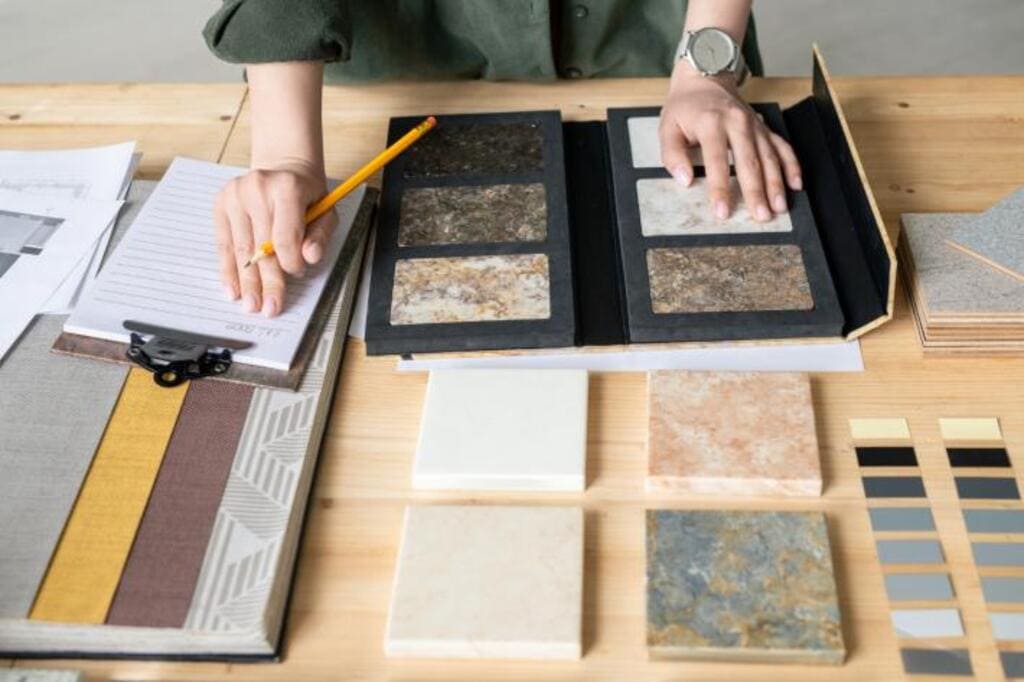
Natural stone such as marble, granite or travertine appears in the more expensive hotels for façade cladding, floors and public areas. It gives a sense of quality that is difficult to fake, and it lasts: properly laid and properly detailed, a stone lobby floor outlives several refurbishments of everything around it. Maintenance is straightforward as well. The argument for stone is never the initial cost. It is the cost per year over the life of the building, and on that measure it is often the cheaper decision.
Tiles and ceramics: earning their keep in the wet rooms
In bathrooms, kitchens and pool areas, tiles and ceramics do the job because they are waterproof and quick to clean, and in a hotel the cleaning time per room is an operating cost you pay every single day of the year. The range of colours, textures and formats is enormous, so the aesthetic argument is settled before it starts. They are durable too, which makes them a sensible long-term investment. The failure is almost never the tile itself: it is the substrate, the movement joints and the waterproofing behind it. That is where the money and the site supervision should go.
Composite materials: light, modern, and worth checking
Composites such as aluminium composite panels (ACP) and fibre-reinforced cement (FRC) have become common in contemporary hotels. ACP is used for external cladding, FRC for structural and decorative elements. Both offer a combination of strength, durability and a modern look, and both are light, quick to install and undemanding to maintain, which shows up as savings over the life of the building.
One note for British and Irish readers, because it comes up in every meeting: after the Grenfell Tower fire, people ask about ACP, known in the UK as ACM, and they are right to. What matters is the core. Panels with a mineral core classified A2-s1,d0 behave very differently from the older polyethylene-cored product. On a hotel, the fire strategy has to be resolved with that classification in hand, in writing. Ask for it before the order goes in, not after.
Material choice is one of those decisions that quietly determines whether a hotel works over its whole life or only in the photographs. Hotel architecture is not a catalogue exercise: hotel architects weigh every material against fire, acoustics, climate, maintenance and the operator’s budget before it reaches a drawing. If you are looking at a hotel build or a conversion on the Costa del Sol, that judgement is worth bringing in early, at brief stage rather than on site.