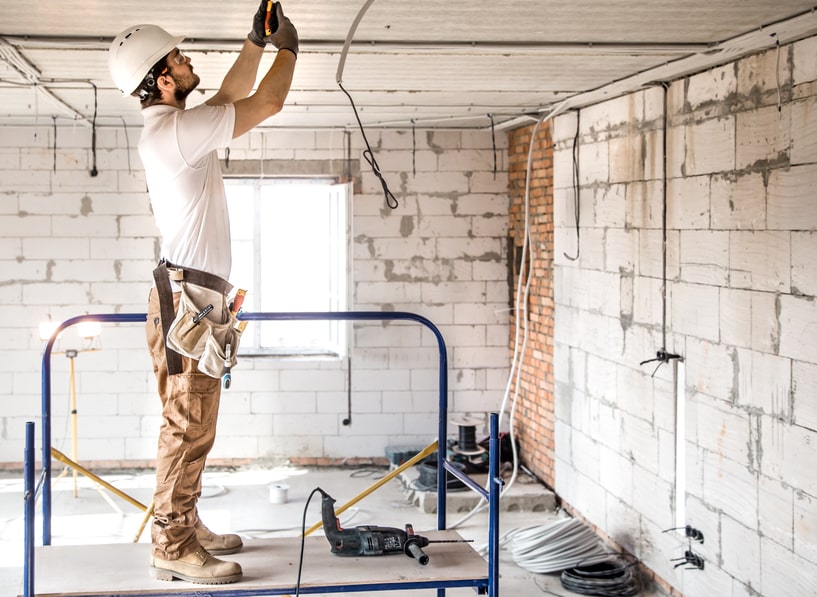
A full refurbishment is what you weigh up when a property needs stripping back rather than tidying up. If that property is in Málaga or on the Costa del Sol, it is worth talking it through with architects in Málaga before you commit to anything.
A full refurbishment means renewing a space completely: layout, services and finishes. That takes a serious budget. It also takes time, organisation and energy, which owners tend to underestimate rather more than the money.
What counts as a full refurbishment under Spanish regulations
Spain has an official document for this: DB HR, the noise protection part of the building regulations (Documento Básico HR, Protección frente al ruido) — roughly what Part E does in England and Wales. It sets out the basic rules and criteria for acoustic protection, it applies to full refurbishments, and it defines them precisely: works in which the partitions, the floor slabs and the envelope of the rooms concerned are all altered substantially and at the same time. Alter those three at once and you are in full refurbishment territory, whatever the builder has written on the quotation.
Complying with the acoustic rules is then compulsory. The single exception is buildings of recognised historic and architectural value, where compliance would seriously damage the building itself.
The definition that matters most, though, sits in the Código Técnico de la Edificación (CTE), Spain’s national building regulations, approved by Royal Decree 314/2006 of 17 March. In regulatory language, what everyone calls a full refurbishment corresponds to rehabilitación. The CTE defines it as works whose purpose is:
- Structural adequacy, to guarantee the mechanical resistance and stability of the building.
- Functional adequacy, meaning the removal of barriers in order to improve accessibility.
- Remodelling of a residential building. Works that change the floor area given over to dwellings, change the number of dwellings, or create dwellings in a building that had none.
Meeting every requirement of the CTE and the noise protection documents calls for a proper architectural project: a signed set of drawings and specifications, not a builder’s quotation. This is the part of what a full refurbishment is that owners most often skip. The technical requirements come with the label, and meeting them means engaging qualified professionals.
When a full refurbishment is the right call
Some situations point clearly towards a full refurbishment, or rehabilitación works in regulatory language. For example:
-
- When the electrical installation or the water pipework has to be replaced. That is unavoidable once the property is more than two decades old, and it is the kind of work that heads off repair bills later.
- When you want to change the layout of the property: opening the kitchen into the living room, enlarging that room, reworking the bathroom, and so on.
- When the materials involved carry a real cost, particularly new floor finishes throughout, or the remodelling of the rooms that drive the budget, such as the kitchen or the bathrooms.
- When insulation and climate control are on the list. Under current energy efficiency rules, more owners are choosing this route. The saving is worth having, all the more with energy priced the way it is.
- When a substantial air conditioning installation is going in.
- When you are carrying out a change of use from commercial premises to dwelling (cambio de uso de local a vivienda — that guide is in Spanish).
Those are the main cases in which a full refurbishment is the sensible route. Each of them needs a technical project drawn up by architects. And before anything starts on site, three things need settling: the materials, what the property actually has to do for you, and the programme. If none of the six cases above applies to your property, you probably do not need a full refurbishment. You need a shorter list of works and the discipline to stop there. That distinction is the practical answer to what a full refurbishment is.